

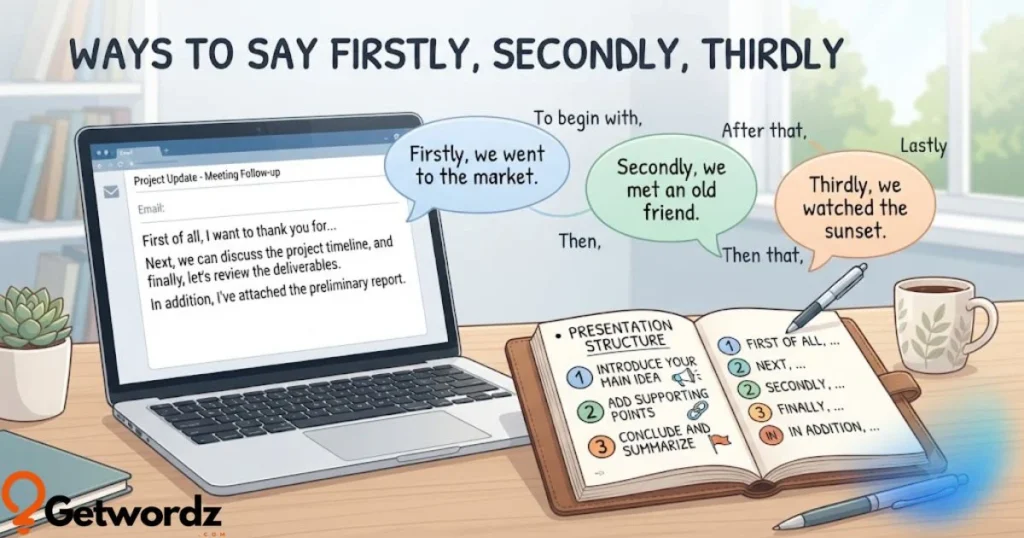
Finding the right words matters because other ways to say “firstly, secondly, thirdly” can completely transform your writing structure, improve idea flow, and remove repetition in writing that often creates a boring writing style or even a robotic tone. Many people rely on sequencing words like firstly, secondly, and thirdly for organizing ideas, but this can feel too formal tone, rigid language, and less human-like in essay writing, email writing, speech writing, and even blog post writing.
That’s why writers search for better alternatives, writing alternatives, and creative transitions to achieve smooth transitions in writing, stronger content clarity, and better reader comprehension. Using warmer phrases, clearer phrases, and natural expressions helps create a more personal tone, conversational tone, and reader-friendly language that improves communication effectiveness.
Whether in professional writing, academic writing, business communication, presentations, or even casual conversations, replacing repetitive transition words with friendly connectors, introductory phrases, and structured writing transitions improves message clarity, idea sequencing, and overall engaging communication. This guide will help you explore natural writing style, dynamic writing, and smooth writing flow so your thoughts feel more meaningful writing, clear expression of ideas, and easy to follow.
What Does “Firstly, Secondly, Thirdly” Mean?
Firstly, secondly, thirdly are classic sequencing words used to organize ideas in a clear order. They help structure writing by showing the step-by-step flow of points, especially in essay writing, speech writing, and academic writing. These terms act as simple transition words that guide readers through arguments or explanations without confusion.
However, while they improve idea organization, overusing them can make writing feel a bit formal tone or repetitive. That’s why many writers now look for better alternatives and more natural expressions to create smoother writing structure and improved reader comprehension in modern communication.
When to Use Firstly, Secondly, Thirdly
You can use firstly, secondly, thirdly when you want to present ideas in a strict, logical order, especially in professional writing, business communication, or academic writing. They are helpful in situations like presentations, reports, or structured explanations where clarity and step-by-step idea sequencing is important.
Still, in more conversational tone or email writing, these phrases can feel a bit rigid. Many writers prefer smooth transitions in writing, friendly connectors, and natural writing style to keep the message more engaging, readable, and human-like.
Is It Professional or Polite to Say Firstly, Secondly, Thirdly?
Yes, using firstly, secondly, thirdly is generally considered professional tone and grammatically correct in formal contexts like academic writing, meetings, and structured reports. It helps maintain order and supports content clarity when presenting multiple points clearly.
However, modern professional writing often favors more creative transitions and warmer phrases for better flow. Using natural expressions improves communication effectiveness, reduces robotic tone, and makes your writing feel more reader-friendly language and engaging in both digital and real-world communication.
Synonyms For Firstly, Secondly, Thirdly
First
Meaning:
“First” is a simple sequencing word used to introduce the opening point in a structured message or explanation. It helps set the direction of communication clearly.
Usage Scenario:
Commonly used in email introductions, professional communication, presentations, and academic writing when starting a list of ideas or steps.
Tone:
Generally neutral, professional, and clear, suitable for both formal and semi-formal contexts.
Best Use Case:
Best for first impression structuring in business emails, reports, and step-by-step explanations.
Examples:
- First, I would like to thank you for your time.
- First, we need to understand the main issue before solving it.
- First, let’s review the project requirements.
- First, I will introduce myself and my role.
Read More: Funny Ways to Say Ladies and Gentlemen Creatively 2026
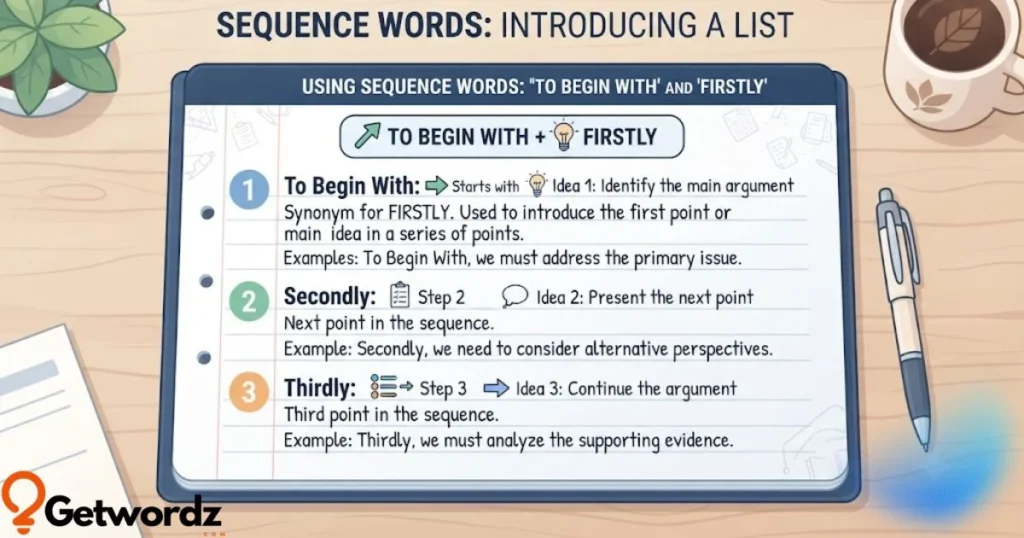
To Begin With
Meaning:
“To begin with” is a natural introductory phrase used to start explaining ideas in a smooth and conversational way.
Usage Scenario:
Used in networking communication, email writing, discussions, and storytelling where a friendly start is preferred.
Tone:
Friendly, conversational, and slightly formal, making communication feel more human-like.
Best Use Case:
Ideal for relationship building and soft introductions in meetings or explanations.
Examples:
- To begin with, let me explain the main purpose of this meeting.
- To begin with, we should focus on improving communication flow.
- To begin with, I’d like to share a quick overview.
- To begin with, the plan looks very promising.
First of All
Meaning:
“First of all” is a widely used transition phrase that emphasizes the first point in a sequence.
Usage Scenario:
Common in professional etiquette, emails, speeches, and structured arguments.
Tone:
Polite, formal, and clear, often used when addressing multiple points.
Best Use Case:
Best for formal communication tone in business writing or presentations.
Examples:
- First of all, thank you for your support.
- First of all, we must ensure quality standards.
- First of all, let’s review the key objectives.
- First of all, I appreciate your quick response.
Initially
Meaning:
“Initially” refers to the starting stage of an action or process before any changes occur.
Usage Scenario:
Used in business communication, reports, and analytical writing.
Tone:
Formal, structured, and professional, often used in technical explanations.
Best Use Case:
Best for describing process flow or early-stage planning.
Examples:
- Initially, the project was planned for three months.
- Initially, we faced several challenges in execution.
- Initially, the results were not very promising.
- Initially, the team worked on research and development.
In the First Place
Meaning:
“In the first place” is used to explain the main reason or original point behind something.
Usage Scenario:
Used in arguments, discussions, and reflective communication.
Tone:
Strong, explanatory, and slightly formal, often used to justify a point.
Best Use Case:
Best for clarifying reasons or correcting misunderstandings.
Examples:
- In the first place, this decision was not well planned.
- In the first place, we agreed on different terms.
- In the first place, the issue started due to miscommunication.
- In the first place, the goal was not clearly defined.
One
Meaning:
“One” is a basic listing word used to introduce the first item in a sequence.
Usage Scenario:
Used in step-by-step explanations, instructions, and presentations.
Tone:
Simple, direct, and neutral, suitable for all contexts.
Best Use Case:
Best for clear structured lists in teaching or instructions.
Examples:
- One, we need better planning.
- One, improve communication skills.
- One, define your goals clearly.
- One, always stay consistent.
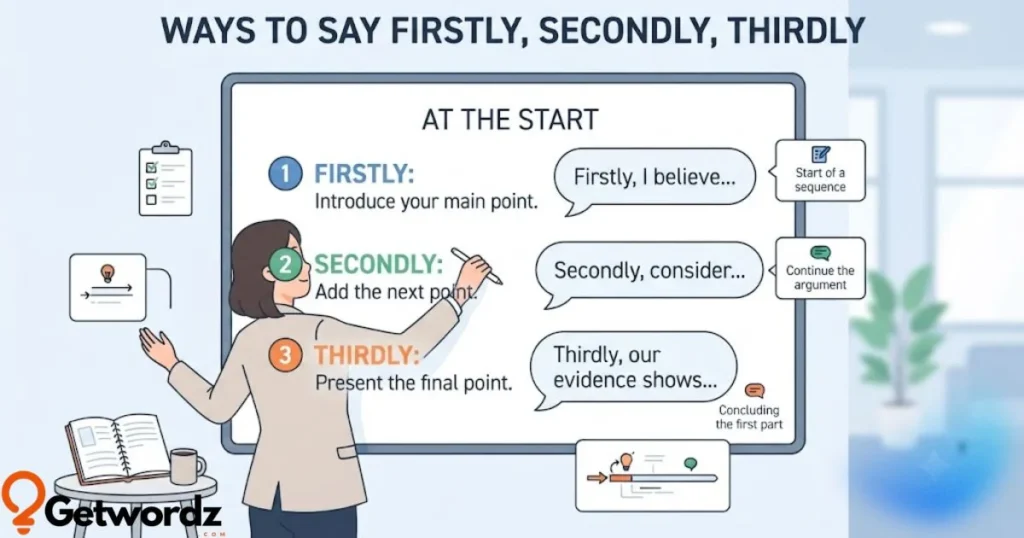
At the Start
Meaning:
“At the start” refers to the beginning stage of an activity or process.
Usage Scenario:
Used in storytelling, planning, and professional discussions.
Tone:
Natural, descriptive, and moderately formal.
Best Use Case:
Best for explaining early actions in a process or timeline.
Examples:
- At the start, everything seemed simple.
- At the start, we focused on research.
- At the start, the team worked remotely.
- At the start, expectations were clearly defined.
Second
Meaning:
“Second” is a sequencing word used to present the next point after the first.
Usage Scenario:
Used in structured writing, speeches, and reports.
Tone:
Formal and organized, helps maintain logical flow.
Best Use Case:
Best for clear progression of ideas in professional communication.
Examples:
- Second, we need to evaluate the results.
- Second, consider the available resources.
- Second, focus on improving performance.
- Second, review the feedback carefully.
Next
Meaning:
“Next” is a smooth transition word used to move to the following idea or step.
Usage Scenario:
Used in presentations, tutorials, and conversations.
Tone:
Friendly, natural, and conversational.
Best Use Case:
Best for easy-flow explanations and instructions.
Examples:
- Next, we will discuss the main challenges.
- Next, add the required details.
- Next, review the final draft.
- Next, move to the implementation phase.
Then
Meaning:
“Then” is used to show the sequence of events or steps over time.
Usage Scenario:
Common in storytelling, instructions, and process descriptions.
Tone:
Neutral, simple, and natural.
Best Use Case:
Best for explaining step-by-step actions.
Examples:
- Then, we submitted the report.
- Then, the team started testing.
- Then, I received the feedback.
- Then, we finalized the plan.
In Addition
Meaning:
“In addition” is used to introduce extra supporting information.
Usage Scenario:
Used in professional writing, reports, and essays.
Tone:
Formal, structured, and informative.
Best Use Case:
Best for expanding ideas and adding value.
Examples:
- In addition, we improved the workflow.
- In addition, the team received training.
- In addition, customer feedback was positive.
- In addition, performance increased significantly.
Subsequently
Meaning:
“Subsequently” refers to something that happens after a previous event.
Usage Scenario:
Used in formal reports, academic writing, and analysis.
Tone:
Highly formal and professional.
Best Use Case:
Best for describing cause-and-effect sequences.
Examples:
- Subsequently, the project was approved.
- Subsequently, changes were implemented.
- Subsequently, sales increased.
- Subsequently, the issue was resolved.
Another
Meaning:
“Another” is used to introduce an additional point or item in a list.
Usage Scenario:
Used in writing, speaking, and presentations.
Tone:
Simple, neutral, and flexible.
Best Use Case:
Best for adding multiple supporting ideas.
Examples:
- Another important factor is communication.
- Another issue is time management.
- Another benefit is cost reduction.
- Another example supports this idea.
Moving On
Meaning:
“Moving on” is a transition phrase used to shift to the next topic.
Usage Scenario:
Used in speeches, discussions, and presentations.
Tone:
Conversational, smooth, and engaging.
Best Use Case:
Best for topic switching without abruptness.
Examples:
- Moving on, let’s discuss the next step.
- Moving on, we will review the results.
- Moving on, here are the key findings.
- Moving on, let’s explore solutions.
Third
Meaning:
“Third” is a sequencing word used to present the third point in an ordered list.
Usage Scenario:
Used in structured writing, formal communication, and presentations.
Tone:
Clear, organized, and professional.
Best Use Case:
Best for maintaining logical structure in multi-point explanations.
Examples:
- Third, we need to analyze the data.
- Third, focus on improvement strategies.
- Third, review the final outcomes.
- Third, implement the feedback received.
After That
Meaning:
“After that” is a sequencing phrase used to show what happens next in a process or timeline.
Usage Scenario:
Common in storytelling, instructions, and step-by-step explanations where events are described in order.
Tone:
Natural, simple, and conversational.
Best Use Case:
Best for explaining clear progression of actions.
Examples:
- After that, we reviewed the feedback.
- After that, the team started implementation.
- After that, I submitted the report.
- After that, everything went smoothly.
Eventually
Meaning:
“Eventually” refers to something that happens after some time or delay.
Usage Scenario:
Used in narratives, reports, and reflective writing.
Tone:
Neutral, slightly formal, and descriptive.
Best Use Case:
Best for showing final outcomes after a process.
Examples:
- Eventually, the project was completed successfully.
- Eventually, they reached a solution.
- Eventually, the issue was resolved.
- Eventually, she agreed to the plan.
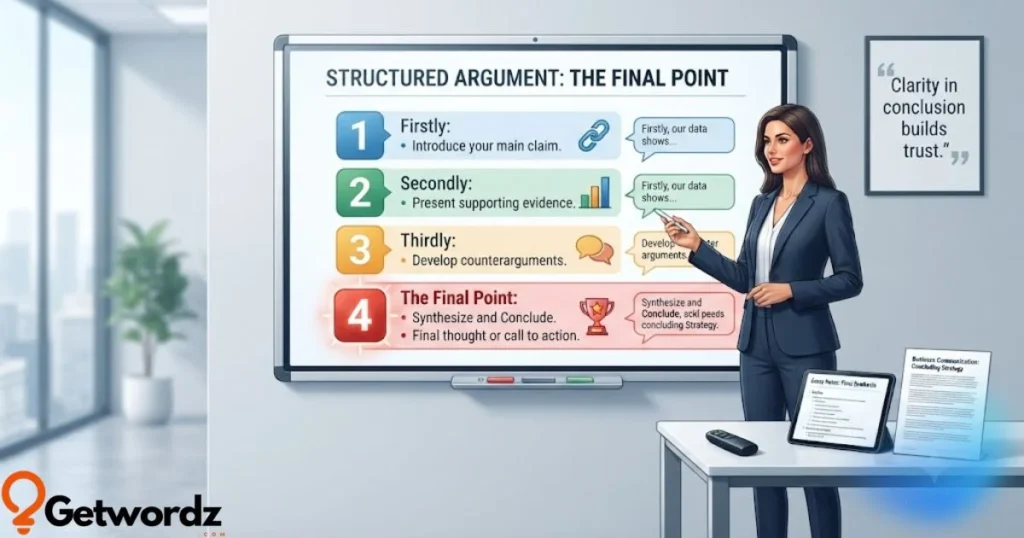
The Final Point
Meaning:
“The final point” is used to introduce the last and most important idea in a list.
Usage Scenario:
Used in presentations, essays, and professional communication.
Tone:
Formal, structured, and emphatic.
Best Use Case:
Best for highlighting key closing arguments or conclusions.
Examples:
- The final point is improving communication.
- The final point focuses on teamwork.
- The final point highlights customer satisfaction.
- The final point summarizes the strategy.
Last
Meaning:
“Last” is a simple sequencing word used to introduce the final item in a list.
Usage Scenario:
Used in basic lists, instructions, and spoken communication.
Tone:
Simple, direct, and neutral.
Best Use Case:
Best for clear and short structured explanations.
Examples:
- Last, we checked the results.
- Last, finalize the document.
- Last, review your work carefully.
- Last, submit the assignment.
Finally
Meaning:
“Finally” is used to introduce the last step or conclusion in a sequence.
Usage Scenario:
Common in speeches, essays, and formal writing.
Tone:
Clear, formal, and conclusive.
Best Use Case:
Best for summarizing or ending structured points.
Examples:
- Finally, we achieved our goal.
- Finally, the report was approved.
- Finally, the meeting ended.
- Finally, we implemented the solution.
Last but Not Least
Meaning:
“Last but not least” is used to introduce the final point that is still important.
Usage Scenario:
Used in speeches, presentations, and introductions.
Tone:
Warm, polite, and engaging.
Best Use Case:
Best for highlighting importance of the final idea.
Examples:
- Last but not least, thank you to the team.
- Last but not least, customer support matters most.
- Last but not least, teamwork drives success.
- Last but not least, consistency is key.
Read More: Funny Ways to Say Lactose Intolerant Cute & Clever 2026
Wrapping Up
Meaning:
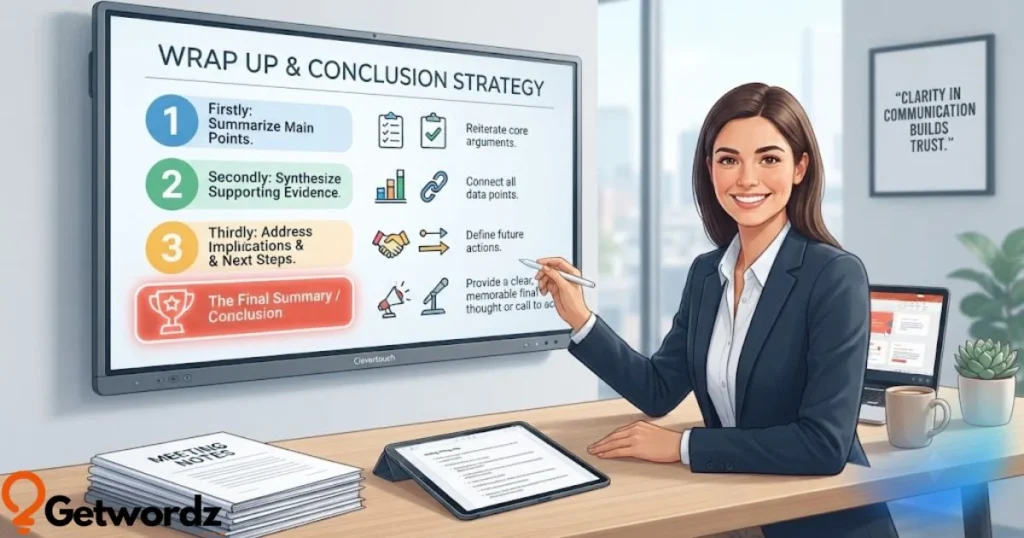
“Wrapping up” means bringing something to a close or conclusion.
Usage Scenario:
Used in presentations, meetings, and informal summaries.
Tone:
Friendly, conversational, and natural.
Best Use Case:
Best for ending discussions smoothly.
Examples:
- Wrapping up, let’s review the main points.
- Wrapping up, we’ve covered everything.
- Wrapping up, here are the key takeaways.
- Wrapping up, thank you for your time.
To Start With
Meaning:
“To start with” is a natural introductory phrase used to begin explaining points.
Usage Scenario:
Used in emails, discussions, and presentations.
Tone:
Friendly, structured, and clear.
Best Use Case:
Best for opening a set of ideas or steps.
Examples:
- To start with, we need a clear plan.
- To start with, let’s define the goals.
- To start with, I will explain the basics.
- To start with, communication is important.
The Next Step
Meaning:
“The next step” refers to the following action in a process.
Usage Scenario:
Used in planning, workflows, and instructions.
Tone:
Professional, structured, and clear.
Best Use Case:
Best for process-driven communication.
Examples:
- The next step is testing the system.
- The next step is gathering feedback.
- The next step is implementation.
- The next step is final approval.
Step One
Meaning:
“Step one” is used to introduce the first action in a process.
Usage Scenario:
Used in tutorials, guides, and instructions.
Tone:
Simple, instructional, and clear.
Best Use Case:
Best for step-by-step guides and learning content.
Examples:
- Step one, open the application.
- Step one, set your goals.
- Step one, gather all information.
- Step one, create a plan.
Following That
Meaning:
“Following that” is used to show what happens after a previous action.
Usage Scenario:
Used in formal writing, reports, and storytelling.
Tone:
Neutral, structured, and professional.
Best Use Case:
Best for clear chronological explanation.
Examples:
- Following that, we analyzed the data.
- Following that, the team met again.
- Following that, changes were applied.
- Following that, results improved.
Read More: Funny Ways to Say Your Fly Is (Open Hilarious Lines) 2026
On Top of That
Meaning:
“On top of that” is used to add extra information or emphasis.
Usage Scenario:
Used in casual conversations, emails, and storytelling.
Tone:
Conversational, expressive, and informal.
Best Use Case:
Best for adding strong supporting points.
Examples:
- On top of that, we met the deadline early.
- On top of that, costs were reduced.
- On top of that, customer satisfaction increased.
- On top of that, the team performed well.
As a Next Point
Meaning:
“As a next point” introduces the following idea in a structured list.
Usage Scenario:
Used in presentations, academic writing, and reports.
Tone:
Formal, structured, and clear.
Best Use Case:
Best for organized argument or explanation flow.
Examples:
- As a next point, we consider user experience.
- As a next point, we evaluate performance.
- As a next point, we analyze costs.
- As a next point, we focus on quality.
Near the End
Meaning:
“Near the end” refers to something happening close to the conclusion.
Usage Scenario:
Used in storytelling, speeches, and summaries.
Tone:
Descriptive and neutral.
Best Use Case:
Best for transitioning toward conclusion.
Examples:
- Near the end, we reviewed the results.
- Near the end, the plan was finalized.
- Near the end, changes were approved.
- Near the end, everything came together.
To Close
Meaning:
“To close” is used to introduce the final remarks or conclusion.
Usage Scenario:
Used in emails, meetings, and formal speeches.
Tone:
Professional, polite, and concluding.
Best Use Case:
Best for ending structured communication.
Examples:
- To close, I appreciate your support.
- To close, let’s summarize the key points.
- To close, thank you for your time.
- To close, we confirm the agreement.
To Begin With, Furthermore, Lastly
Meaning:
This is a structured sequencing trio used to organize ideas in order: starting, adding, and concluding.
Usage Scenario:
Used in academic writing, essays, and formal presentations.
Tone:
Highly structured, formal, and clear.
Best Use Case:
Best for well-organized arguments and professional writing.
Examples:
- To begin with, we define the problem. Furthermore, we explore solutions. Lastly, we summarize findings.
- To begin with, communication is key. Furthermore, teamwork improves results. Lastly, consistency ensures success.
- To begin with, gather data. Furthermore, analyze it carefully. Lastly, present conclusions.
- To begin with, set objectives. Furthermore, assign roles. Lastly, evaluate progress.
One, Another, Finally
Meaning:
A simple numbered sequencing pattern used to present ideas clearly in order.
Usage Scenario:
Used in instructions, speaking, and basic writing structure.
Tone:
Simple, clear, and easy to follow.
Best Use Case:
Best for basic structured explanations and lists.
Examples:
- One, improve planning. Another, enhance communication. Finally, review results.
- One, set goals. Another, track progress. Finally, evaluate success.
- One, gather resources. Another, execute plan. Finally, analyze outcome.
- One, define problem. Another, explore solutions. Finally, conclude findings.
First and Foremost
Meaning:
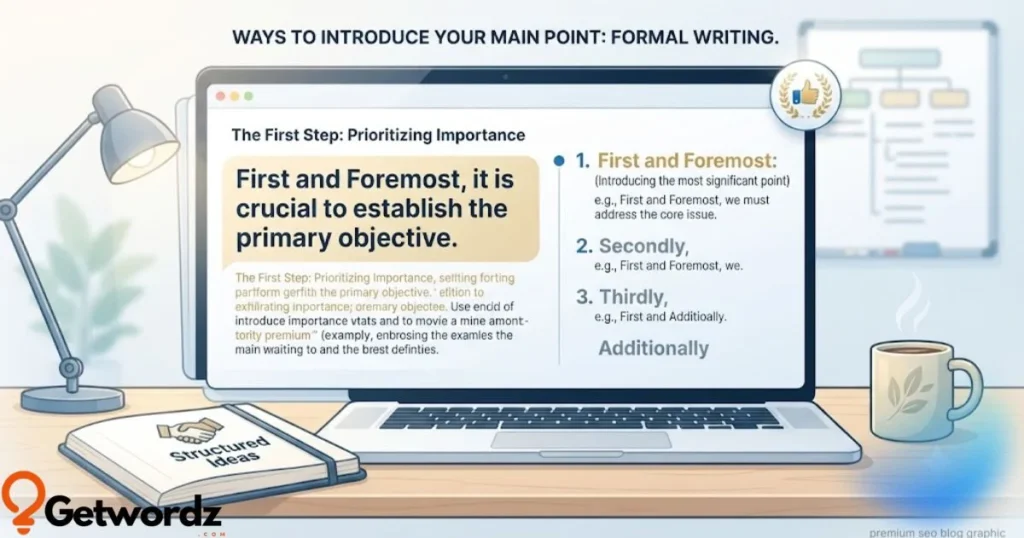
“First and foremost” emphasizes the most important initial point.
Usage Scenario:
Used in formal communication, speeches, and professional writing.
Tone:
Strong, respectful, and formal.
Best Use Case:
Best for highlighting priority or importance at the start.
Examples:
- First and foremost, thank you for your support.
- First and foremost, safety is our priority.
- First and foremost, we value customer trust.
- First and foremost, communication must be clear.
The First Step
Meaning:
“The first step” is a sequencing phrase used to introduce the initial action in a process or plan.
Usage Scenario:
Common in instructions, tutorials, business planning, and academic writing where step-by-step clarity is needed.
Tone:
Clear, structured, and professional, suitable for both formal and instructional communication.
Best Use Case:
Best for guides, workflows, and process explanations where clarity and order matter.
Examples:
- The first step is to define your goals clearly.
- The first step involves gathering all necessary data.
- The first step is creating a proper plan.
- The first step should focus on understanding the problem.
To Open With
Meaning:
“To open with” is a natural introductory phrase used to begin speaking or presenting an idea.
Usage Scenario:
Used in speeches, meetings, email introductions, and presentations to start smoothly.
Tone:
Friendly, conversational, and slightly formal, making communication feel natural and engaging.
Best Use Case:
Best for opening remarks or starting discussions in a polite and structured way.
Examples:
- To open with, I’d like to thank everyone for joining.
- To open with, let me explain the purpose of this meeting.
- To open with, we will discuss the main objectives.
- To open with, I want to share a quick overview.
In Turn
Meaning:
“In turn” means as a result or one after another in sequence, showing a chain of actions or responses.
Usage Scenario:
Used in formal writing, analysis, and communication flow descriptions.
Tone:
Formal, logical, and explanatory, often used in structured or academic content.
Best Use Case:
Best for showing cause-and-effect relationships or sequential reactions.
Examples:
- Good communication improves teamwork, which in turn increases productivity.
- Better planning leads to efficiency, which in turn saves time.
- Customer satisfaction improves trust, which in turn boosts sales.
- Clear instructions reduce confusion, which in turn improves performance.
Primarily
Meaning:
“Primarily” means mainly or most importantly, used to highlight the main focus or reason.
Usage Scenario:
Common in academic writing, business communication, reports, and explanations.
Tone:
Formal, professional, and precise, often used in analytical contexts.
Best Use Case:
Best for emphasizing the main idea or core purpose of something.
Examples:
- Primarily, the goal is to improve communication.
- The project is primarily focused on user experience.
- This system is primarily designed for efficiency.
- The issue is primarily caused by miscommunication.
Afterward
Meaning:
“Afterward” is a sequencing word used to describe something that happens later in time after a previous event.
Usage Scenario:
Common in storytelling, reports, emails, and step-by-step explanations where events are described in order.
Tone:
Neutral, clear, and slightly formal, suitable for both professional and general writing.
Best Use Case:
Best for showing what happens next in a timeline or process.
Examples:
- Afterward, we reviewed the final results.
- Afterward, the team discussed improvements.
- Afterward, I submitted the report.
- Afterward, everything was finalized.
Later On
Meaning:
“Later on” is a casual transition phrase used to refer to something that happens after some time.
Usage Scenario:
Used in conversations, storytelling, informal emails, and narration to keep flow natural.
Tone:
Informal, friendly, and conversational, making communication feel relaxed and natural.
Best Use Case:
Best for casual communication or storytelling where a soft transition is needed.
Examples:
- Later on, we decided to change the plan.
- Later on, I realized the mistake.
- Later on, we met again to discuss details.
- Later on, everything became clearer.
Moreover
Meaning:
“Moreover” is a formal linking word used to add extra supporting information to strengthen an argument.
Usage Scenario:
Common in academic writing, business reports, essays, and professional communication.
Tone:
Formal, logical, and persuasive, often used to emphasize additional points.
Best Use Case:
Best for adding important supporting ideas in structured writing.
Examples:
- Moreover, the strategy improved overall performance.
- Moreover, customer satisfaction increased significantly.
- Moreover, the process became more efficient.
- Moreover, the results were highly positive.
Pros and Cons of Using Other Ways to Say “‘Firstly, Secondly, Thirdly’
Pros
- Improves idea organization and makes writing easy to follow
- Creates a clear structured flow of information in essays and reports
- Helps in academic writing and formal presentations for better clarity
- Makes step-by-step explanation simple for readers and listeners
- Supports logical sequencing of thoughts in professional communication
Cons
- Can make writing feel repetitive and boring if overused
- Often creates a rigid language style instead of natural flow
- May sound too formal tone in casual conversations or emails
- Reduces human-like writing and makes content feel mechanical
- Limits creativity by restricting use of natural transitions and variations
Conclusion
Using sequencing words like firstly, secondly, thirdly can definitely help in creating structured writing, improving idea flow, and maintaining clear content clarity in essays, reports, and professional communication. They are especially useful in academic writing and formal presentations where logical order is important.
However, modern communication prefers more natural expressions, smooth transitions, and human-like writing to avoid a robotic tone or repetitive writing style. By mixing traditional sequencing words with creative alternatives like to begin with, moreover, afterward, in turn, and later on, you can make your writing more engaging, flexible, and reader-friendly. The key is balance use structure when needed, but keep your language natural and dynamic.
FAQs
What does “firstly, secondly, thirdly” mean in writing?
It is a set of sequencing words used to organize ideas in a clear and logical order.
Are “firstly, secondly, thirdly” still correct to use?
Yes, they are grammatically correct and widely used in formal writing and academic contexts.
Why should we avoid overusing sequencing words?
Overuse can make writing feel repetitive, rigid, and less natural, affecting readability.
What are better alternatives to these words?
You can use to begin with, next, moreover, afterward, finally, in addition, and similar phrases.
Where should sequencing words be used most?
They are best used in essays, reports, presentations, and structured explanations.
Can we use them in emails?
Yes, but in modern email writing, more natural transitions are often preferred.
Do these words improve communication clarity?
Yes, they help improve logical flow and idea sequencing when used properly.
What is the main disadvantage of using them?
They can make writing sound stiff or robotic if used too frequently.
How can I make my writing more natural?
Use a mix of creative transitions, conversational tone, and varied sentence structure.